 Support Ukraine







Redesign of the ‘Pershyi’ news portal: news feed, native advertising, reader-submitted content
Social news channel

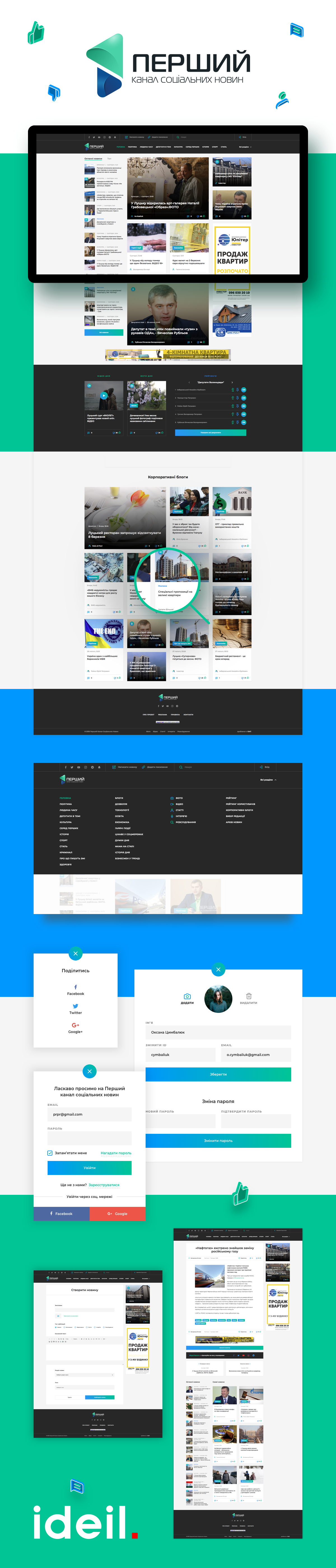
‘Pershyi’ was changing its approach to presenting information — and the website had to evolve alongside the editorial model. We redesigned the news feed, put together a design system based on blocks, integrated advertising into the page structure and developed the UGC mechanism that underpins the project.
The challenge: to relaunch the news delivery without disrupting what works
Redesigning a news portal is always like working with a living organism. The site cannot be shut down: the editorial team publishes daily, the archive has been indexed for years, and the audience has established habits.
We faced three constraints:
- Not to lose search traffic. For a regional media outlet, the archive comprises tens of thousands of pages that drive organic traffic. Changing the URL structure without proper redirects would take months to recover rankings.
- Not to disrupt readers’ habits. The audience comes for the news feed. The new visual language was not meant to complicate the main scenario — ‘visited, saw what had happened’.
- We didn’t want to turn the site into a design mess. The editorial team publishes content in various formats every day. The design had to cope with this without a designer being involved in every single publication.
We ran the project under the internal codename ‘Reborn’ — it wasn’t a cosmetic refresh, but a complete front-end relaunch on top of the existing editorial infrastructure.
The news feed and visual hierarchy
The homepage opens with a traditional news feed — a deliberate choice. In news media, readers arrive with a specific intention, and any ‘magazine-style’ landing page between them and the news reduces engagement.
The key work lay not in the feed itself, but in the hierarchy within it. Readers must be able to distinguish the day’s main story from a secondary one in a split second — without ‘Top Stories’ headings or explanations. This is achieved through size, spacing and rhythm, rather than text labels.
For the editorial team, this means a tool for managing attention: raising a story’s priority is a single action in the admin panel, rather than a page layout.
Design system: a vocabulary of blocks instead of a set of pages
During the redesign process, we completely reimagined the project’s visual language and compiled a block library — a set of elements from which the editorial team can create new combinations, much like a construction set.
- The new content format does not require a designer or developer;
- the website does not become visually cluttered as the number of sections increases;
- special projects and advertising sections are built using the same components.
The effect is evident over the solution’s lifetime: the website has been running on this design system since its launch, and during this time the editorial team has added dozens of new sections and formats — from ‘Investigations’ and ‘Interviews’ to themed projects such as ‘Trending Businesspeople’ and ‘First in the Kitchen’. None of them required separate layout work.
This is a standard approach in product development but remains a rarity in regional media: most websites, after two years of operation, turn into a collection of incompatible templates.
Monetisation: advertising within the structure, not on top of it
Advertising is the main source of income for regional media and, at the same time, the main reason why readers use ad blockers.
We’ve changed our approach to ad placement: ad positions are integrated into the feed’s structure and use the same grid and typography as editorial content. The format reads as part of the website, rather than as an inserted banner.
Technically, the website combines two sources of revenue — programmatic advertising via Google AdSense and direct sales by the editorial team: banner adverts, corporate blogs, special projects and the ‘Reference’ section. For regional media, it is direct sales that generate profit margins, so the advertising inventory for these was designed separately, rather than on a residual basis.
UGC: the reader as a co-author of the day’s story
‘Pershyi’ is built around the idea that the agenda is not shaped by the editorial team alone. Registered users can publish their own news stories, run a corporate blog and feature in the authors’ rankings.
- registration and authorisation, including via social media;
- an editorial interface for non-professional authors — simple enough for someone with no experience to publish content on their first attempt;
- moderation of incoming content prior to publication;
- a ranking system and public user profiles;
- corporate blogs as a separate content type with its own access and monetisation logic.
The latter is a rare case where the UGC feature also serves as an advertising product: businesses pay for the opportunity to run a blog on the media platform.
Technology and performance
- Backend: Laravel
- Front-end: jQuery, Bootstrap, Slick, lightGallery
- Push notifications: OneSignal — a proprietary news delivery channel, independent of social media algorithms
- Advertising: Google AdSense + direct inventory
- Infrastructure: static files and media hosted on a separate server, Cloudflare in front of the site — handles traffic spikes on days when major news breaks
- Archive: fully migrated whilst retaining the URL structure
Speed is no mere nicety for a news site. Readers access the site on their mobiles, often with a poor connection, and compare you not with other media outlets, but with their social media feed, which has already loaded. If your portal slows down during traffic peaks — start by auditing your site’s speed.
Result
- The site ranks among the top five news resources in Volyn by audience and shows steady growth
- The design system has been in use without any redesign since its launch — the editorial team has expanded sections and formats without involving a developer
- The push notifications and UGC have provided the media outlet with two sources of traffic that are independent of social media algorithms
- The archive was migrated without losing search rankings
What we’ve learnt from working with media organisations
‘Pershyi’ is one of the projects on which we have built our expertise in developing news websites and media platforms. Our clients in this sector include Forbes Ukraine, TSN, Hromadske and UNITED24.
Each of these projects faced the same key challenges: a fast-loading news feed, an editorially controlled hierarchy, monetisation without compromising the reader experience, and preserving the archive during migration. We have therefore consolidated some of these solutions into a standalone product — Published!, a CMS for news organisations with built-in SEO, paywall, multilingual support and AI tools for editorial teams.
If you’re launching a new media outlet, it makes sense to check out Published! rather than opting for bespoke development from scratch. If you already have a working portal with its own logic, we can handle the redesign and further development using your existing tech stack.
Frequently Asked Questions
Which CMS should I choose for a news publication?
For a new media outlet with standard requirements, a ready-made solution such as Published! or Ghost: faster launch and lower cost of ownership. A bespoke development is justified when there’s a non-standard model: UGC, complex monetisation, or integrations with the editorial team’s internal systems.
Is it possible to carry out a redesign without losing search rankings?
Yes, provided you retain the URL structure or set up 301 redirects for each archive page, carry over the micro-markup and do not change the heading structure. A dip in rankings for 2–4 weeks after launch is normal; full recovery usually takes up to two months.
What should you do with an archive containing tens of thousands of articles?
Migrate it in its entirety. A regional media archive is the ‘long tail’ of organic traffic, which for years has been bringing readers to specific events, names and addresses. Trimming the archive for the sake of a ‘clean slate’ is the most costly mistake in a redesign.
Will the editorial team be able to update the homepage themselves?
Yes. We place control over the prioritisation of content, sections and categories in the admin panel — the editorial team’s day-to-day work should not depend on the developer.
How can a news site be monetised apart from banner adverts?
Viable business models for regional media include direct sales of advertising inventory, corporate blogs and special projects, paid reference sections, and push notifications. For publications with a loyal core audience, paywalls and membership schemes are added — we’re finalising this scenario via Published!.
Are you planning to launch a media outlet or redesign a news portal? Tell us about your project — we’ll get back to you with a quote within two working days.